2026
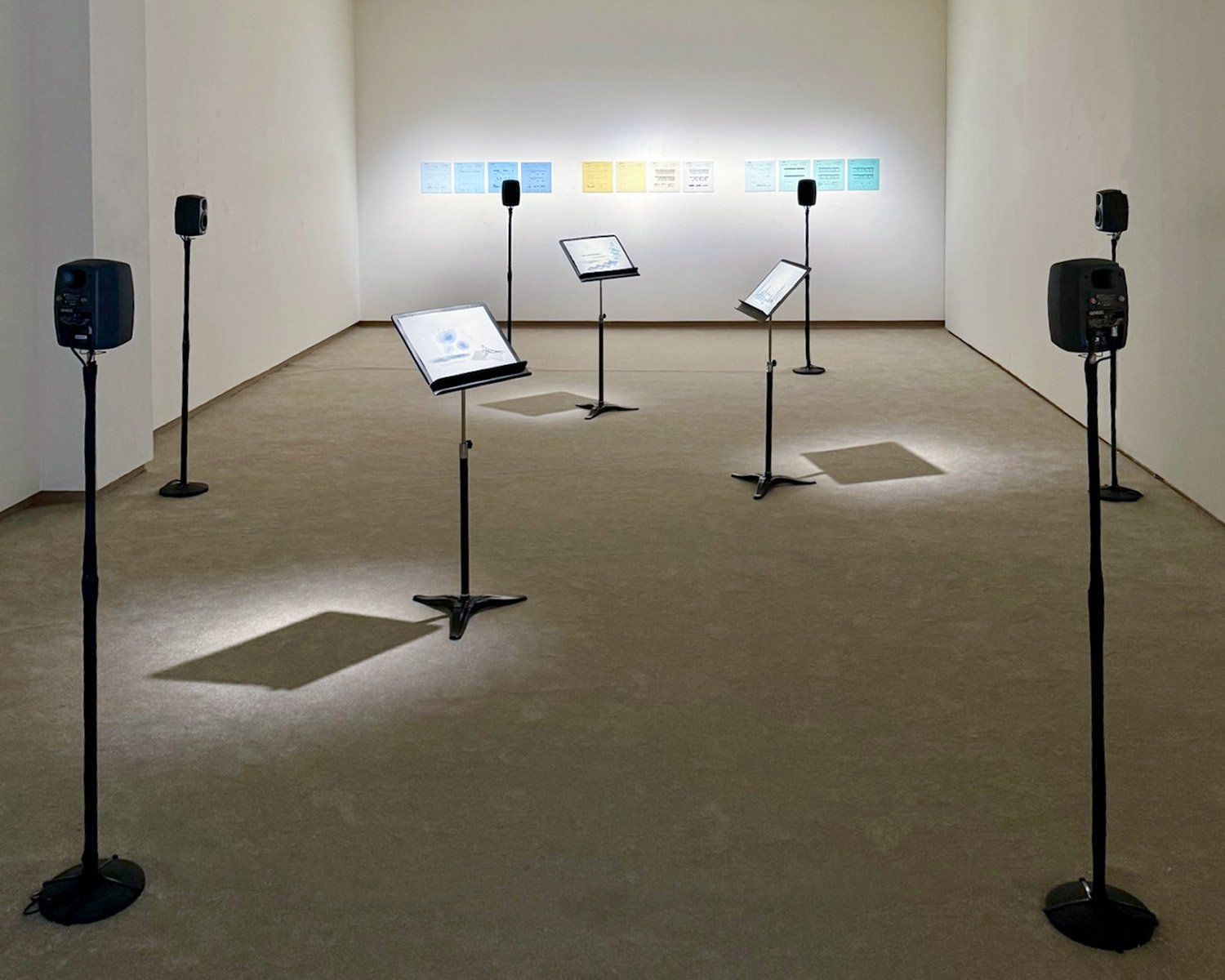
Eight-channel sound installation, 19 min 18 sec, looped
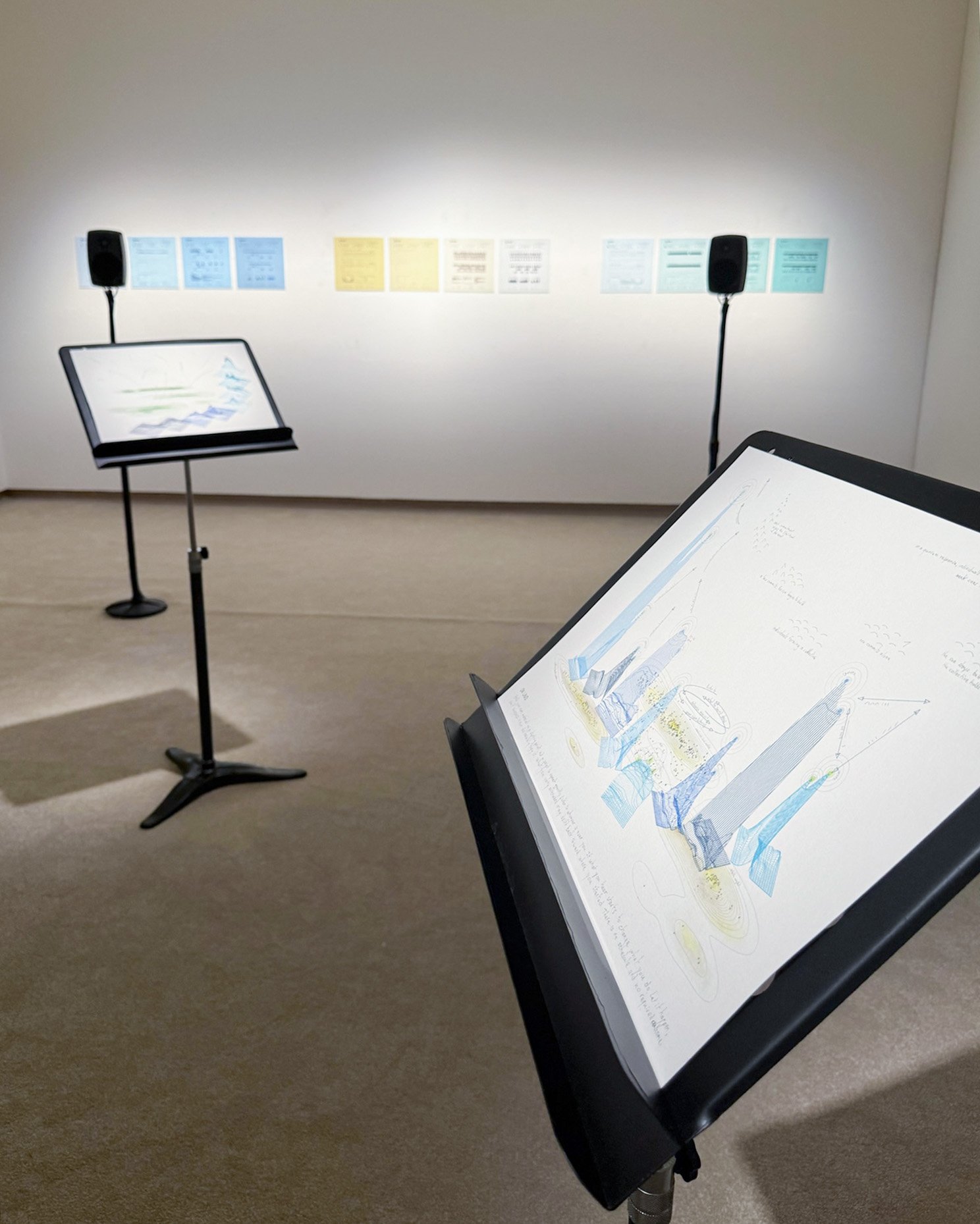
3 scores: ink, pencil and watercolour on paper, 45 × 32 cm each
12 analysis prints, 31 × 31 cm each
Dimensions variable
Changwon Sculpture Biennale, South Korea, 2026
The East Asian–Australasian Flyway is the route migratory birds follow between the Arctic and Australasia, passing through East and Southeast Asia. The recordings in this installation were made in Hong Kong, a place of pause, feeding, and passage along this route. The work begins with listening closely to these calls, long enough to hear their structure and not only recognise the species.
Twelve analysis prints on the wall, three scores on music stands, and eight speakers shape the space, a place to gather, listen, and move through. The prints borrow their tools from bioacoustics (spectral measurement, temporal density, rhythmic contour). The measurements are precise, but they are a starting point. Each print makes a call legible enough for a singer to read, interpret, and carry into improvised voice. What the prints hold is this act of translation, and the distance between the bird and what we can make of it.
The work unfolds in three movements (descent, on land, ascent) that follow the shape of a stopover: arriving, attuning to one another, and departing. Each movement gives the singers open instructions derived from this analysis. Rather than imitating birds, they work from what remains of a call’s structure, moving between single voices and collective sound, between a legible phrase and a shared mass. Each singer listens to those nearest to them. One voice emerges and others answer; the sound settles, then shifts. Birds that roost or take flight together often decide in a similar way. Individual signals accumulate until their combined weight crosses a threshold, and the group moves as one, with no single voice leading. Biologists call this a quorum. The ensemble works close to that threshold, without forcing a resolution.
The electroacoustic elements make the birds present without representing them. Granular synthesis breaks the recordings into shifting clouds of fragments that gather and disperse across the eight speakers the way a flock moves through air, with close, localisable trajectories for single sources and wider diffusion for denser masses. The voices are placed in the same field and follow the same principle, each responding to its neighbours. At moments, voice and birdsong pass through the same granular process. As they interfere and partly resemble each other, the boundary between them begins to blur.
From migration, the work borrows passage, an order that holds at the edge of disorder, and the threshold where one thing becomes another. Inhabiting that logic, even briefly and imperfectly, may suggest what a collective can do when it moves without a conductor.
With voices from the Chinese University Chorus: Leon Chu / Waris Sit / Eunice Mau / Joel Kwok / Monica Chan / Alison Cheung / Rachael Ho / Chloe Li / Joey Chan / Kelvin Cheung / Shirley Hui / Angela Choy / Yeukie Lee / Yoyo Ng
Sound recording engineer: Tse Kam Po / Lok Hang Wong
All bird recordings courtesy of Geoff Carey
Many thanks to Grace Hui, Carmen Or (Manager, Conservation Research WWF-Hong Kong) and special thanks to Bo Mok.